
Moving from London to the Home Counties: What to consider
Updated: 4 days ago
The Home Counties aren’t a single, fixed list. Berkshire, Essex, Buckinghamshire, Surrey, Kent and Hertfordshire are commonly included, while Bedfordshire, Cambridgeshire, Oxfordshire, Hampshire and East and West Sussex may also be counted. Moving from London to the Home Counties could mean a short journey beyond the capital or a bigger change to a quieter, more rural routine.
Wanting more space or a different pace is understandable, but the right move depends on more than the property. Your commute, family needs, local services and preferred community all matter. This guide explains what the Home Counties include, how daily life can differ from London, and what to consider before choosing where to settle. You’ll have a clearer framework for comparing areas and deciding whether life outside the capital fits your plans.
Table of Contents
1. Adjusting to life outside London
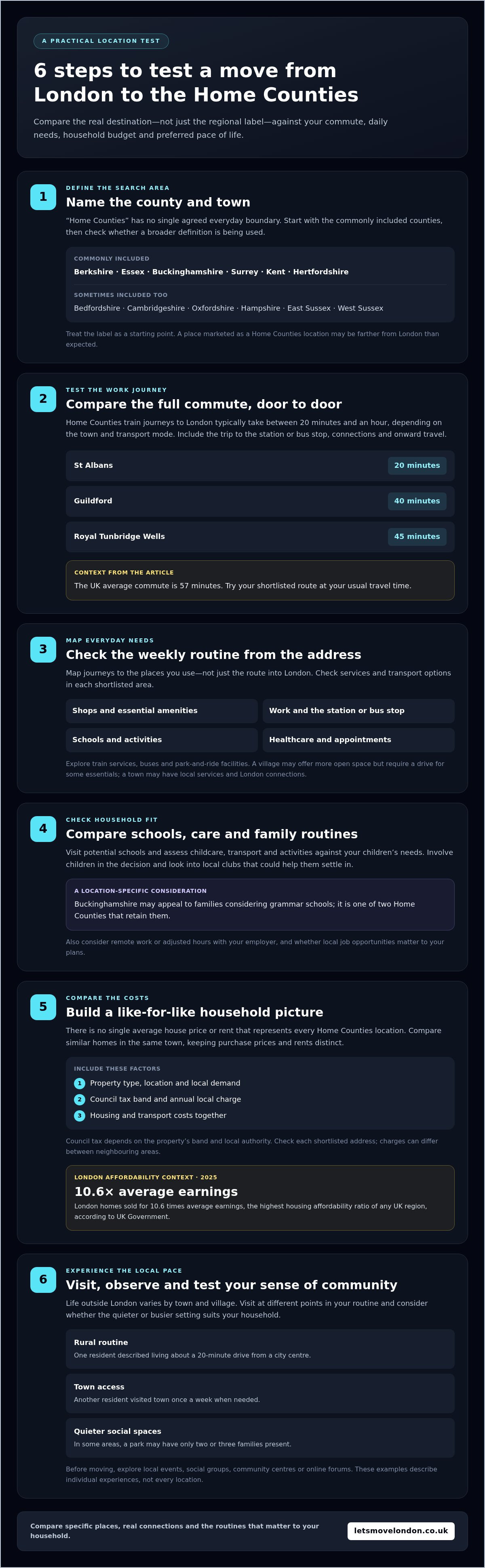
Life outside London can feel quieter, but the change depends on the town or village you choose. One rural resident described living about a 20-minute drive from a city centre, while another visited town once a week when needed. These examples show why “country life” can mean different routines. Before deciding, map everyday journeys to shops, work, schools and healthcare from the specific address.
Plan the commute around your actual working pattern. Home Counties train journeys to London typically take between 20 minutes and an hour, depending on the town and transport mode. Guildford is described as a 40-minute commute, St Albans as 20 minutes, and Royal Tunbridge Wells as 45 minutes. The UK average commute is 57 minutes. Try the route at your usual travel time, and include the journey to the station or bus stop.
Transport choices shape everyday errands as well as work journeys. Explore train services, buses and park-and-ride facilities in shortlisted areas, then consider how you would get to shops, schools and activities. Many Home Counties locations also provide straightforward road links to major travel hubs like Heathrow, Gatwick, Stansted or Luton; for frequent travellers, resources like comparecheapairportparking.co.uk can help with comparing terminal and meet-and-greet parking options. A village may offer more open space but require a drive for some essentials. A town may provide local services while keeping London within commuting distance. Compare your weekly routine, including school journeys and appointments, rather than relying on a map alone.
Community life may also take time to settle into. People moving to the Home Counties are advised to attend local events and join social groups, community centres or online forums before moving. For families, local clubs and activities can help children build friendships; involve them in the decision and visit potential schools. In some areas, a park may have only two or three families present. That quieter atmosphere can suit some households, while others may prefer a busier town centre.
2. Definition and boundaries of the Home Counties
The Home Counties are the counties around London, but there is no single agreed list in everyday use. Berkshire, Essex, Buckinghamshire, Surrey, Kent and Hertfordshire are commonly included. Some definitions also extend to Bedfordshire, Cambridgeshire, Oxfordshire, Hampshire, East Sussex and West Sussex. This broader usage matters when comparing locations: a property described as being in the Home Counties may be farther from London than you expect.
Treat the term as a starting point, not a precise boundary. Identify the county and town of each property you’re considering, then compare the actual route into London, nearby amenities and local services. A village in Hampshire and a town in Hertfordshire, for example, may both be marketed as Home Counties locations but offer very different journeys and day-to-day surroundings.
Commonly included: Berkshire, Essex, Buckinghamshire, Surrey, Kent and Hertfordshire.
Sometimes included too: Bedfordshire, Cambridgeshire, Oxfordshire, Hampshire, East Sussex and West Sussex.
The Greater South East is a broader regional label, not a synonym for the Home Counties. Its described reach includes Peterborough, Norwich and Cambridge to the north; Canterbury and Ipswich to the east; Portsmouth, Eastbourne and Brighton to the south; and Oxford and Southampton to the west. The region’s county list also includes Norfolk and Suffolk. Use these broader names carefully when searching, as results may include locations well beyond the counties usually associated with London.
Compare specific places rather than relying on a regional label. Commuter towns cited across the area include Hungerford, Bicester, Great Missenden, Letchworth, Bray, Horley, Egham, Balcombe, Oxted, Pangbourne and Sevenoaks. For each place, check the property’s distance from its nearest station, town centre and essential amenities. This makes “Home Counties” more useful for planning your move: focus on a defined destination and its real connections, services and surroundings.
3. Personal considerations during a move
Families might shortlist places such as St Albans, Guildford and Royal Tunbridge Wells, then compare local schools, childcare, transport and activities. Buckinghamshire may appeal to families considering grammar schools, as it is one of two Home Counties that retain them. Visit the area and assess each school and childcare option against your children’s needs.
There is no single average house price or rent that represents every Home Counties location. Compare similar homes in the same town, separating purchase prices from rents; property type, location and local demand all affect the comparison with London. In 2025, London homes sold for 10.6 times average earnings, the highest housing affordability ratio of any UK region, according to UK Government.
Council tax depends on the property’s band and local authority, so bills can differ between neighbouring areas. Check the band and annual charge for each shortlisted address, then include them alongside housing and transport costs in your household budget. Don’t assume local charges will stay the same when you cross a county boundary.
Home Counties journeys to London typically take between 20 minutes and an hour by train, depending on the town and transport mode. Compare the full trip, including travel to the station, connections and onward travel, then trial the route at your usual commuting time. For moving from London to the Home Counties, this door-to-door test helps reveal how a new address fits your work routine.
Before choosing, visit each area and check schools, healthcare, amenities, transport links and community life. If you have children, involve them in the decision and explore local clubs that could help them settle in. Discuss remote work or adjusted hours with your employer, and consider local job opportunities if a career change becomes necessary. Planning your move from London to the Home Counties also means organising belongings, access and timing around your new home and household needs.
4. Reasons families move from London to the Home Counties
For some families, the main motivation is finding a home and setting that better fit changing needs. In 2025, homes in London sold for 10.6 times average earnings, giving the capital the highest housing affordability ratio of any UK region, according to UK Government. That figure helps explain why households compare London with nearby counties, but each town and property brings different trade-offs.
Which Home Counties towns have the best commuter links to central London? St Albans in Hertfordshire is described as a 20-minute commute, Guildford in Surrey as 40 minutes, and Royal Tunbridge Wells in Kent as 45 minutes. Treat these as town-level examples: your door-to-door journey also depends on the station, service and onward route.
The advantages can include a different pace, more room and access to countryside while staying within reach of London. Potential drawbacks include longer or more complicated journeys, fewer nearby amenities in some villages, and the time it takes to build a local social life. A household travelling to London daily may weigh these factors differently from one commuting occasionally.
To make a well-informed decision, visit shortlisted towns on an ordinary weekday and at the weekend. Test the commute, review local schools and services, and consider road noise, flight paths and village amenities near each property. Then assess how the location works for every family member, not just the person travelling to London. This practical check can show whether the extra space supports the routine you want.
Once you’ve chosen a destination, organise the move around the property access, household contents and travel distance. Plan your relocation carefully so the practical transition supports the new routine you’re moving for.
Let's Move London: Moving
Let's Move London can help with the practical work of relocating your household from London to a Home Counties address. Once you’ve chosen where to live, use its moving service to coordinate the transfer of your belongings. If there’s a gap between leaving one property and settling into another, secure storage can help manage the transition.
Share the details that shape your move, including your destination, access arrangements and the belongings to be moved. This gives the relocation a clear starting point and helps organise the practical requirements around your new home. With the move planned, you can focus on setting up family routines and getting to know your chosen area.
Contact Let's Move London to discuss your move and the support you need.
Make your next move with confidence
Before committing, write down what your household needs from its next chapter. Separate essentials from preferences, then use the list to guide property decisions, timing and preparation. This keeps the move focused on the life you want to build, not only the address you’re leaving.
Moving from London to the Home Counties is a substantial change, but a clear plan can make the transition more manageable. Set aside time to organise belongings, decide what needs to travel first and prepare for moving day. If your plans change, revisit your priorities rather than rushing into choices that don’t suit your household.
When you’re ready to plan the move, contact Let's Move London about your move. Take the next step at a pace that works for you, with a clear destination and a plan for settling in.
Frequently Asked Questions
What Are the Home Counties?
The Home Counties are the counties surrounding London, but the term has no fixed administrative boundary. It is a regional label used in different ways, so a place described as being “in the Home Counties” may be at varying distances from the capital. For a house search, use the county and town name, then assess the specific address rather than relying on the label alone.
Where Do People Move After London?
After leaving London, people often move to the South East or East regions: 58 per cent of people moving from London chose those regions. These destinations cover a wide area, not just towns close to the capital. The wider Greater South East reaches from Peterborough and Norwich to Brighton and Southampton, so compare actual travel connections and daily needs before choosing.
Which counties are considered the Home Counties around London?
The six counties most commonly counted are Berkshire, Buckinghamshire, Essex, Hertfordshire, Kent and Surrey. Some definitions also include Bedfordshire, Cambridgeshire, Hampshire, Oxfordshire, East Sussex and West Sussex. This variation can affect property searches and local descriptions. When narrowing your options, search by destination county and town, then assess the specific address and its transport connections.
What are the average house prices and rents in the Home Counties compared with London?
There is no single average house price or rent for the Home Counties; costs vary by town, property type, location and demand. Compare similar homes in the same area, and note that London homes sold for 10.6 times average earnings in 2025, the highest housing affordability ratio of any UK region.



Comments