
Navigating Red Routes on Moving Day in London
A moving van cannot treat a London red route like an ordinary kerbside loading spot. Stopping, parking and loading are prohibited except in designated areas, and a bay is usable only when its markings and nearby sign allow it. Navigating red routes on moving day in London starts with checking the exact frontage, not making assumptions based on the postcode or borough.
It’s understandable to expect a brief stop while furniture is carried in, but even a short pause on a restricted stretch can lead to a penalty. This guide explains the difference between single and double red lines, what loading bays permit, and how to check whether your planned stopping point is allowed. It also covers when a nearby side street may be more practical, why borough parking arrangements may not apply to a TfL-managed red-route frontage, and when red-route-specific planning or permission may be needed. Consider the stopping point and building access together to reduce last-minute surprises.
Table of Contents
What is the difference between single and double red lines?
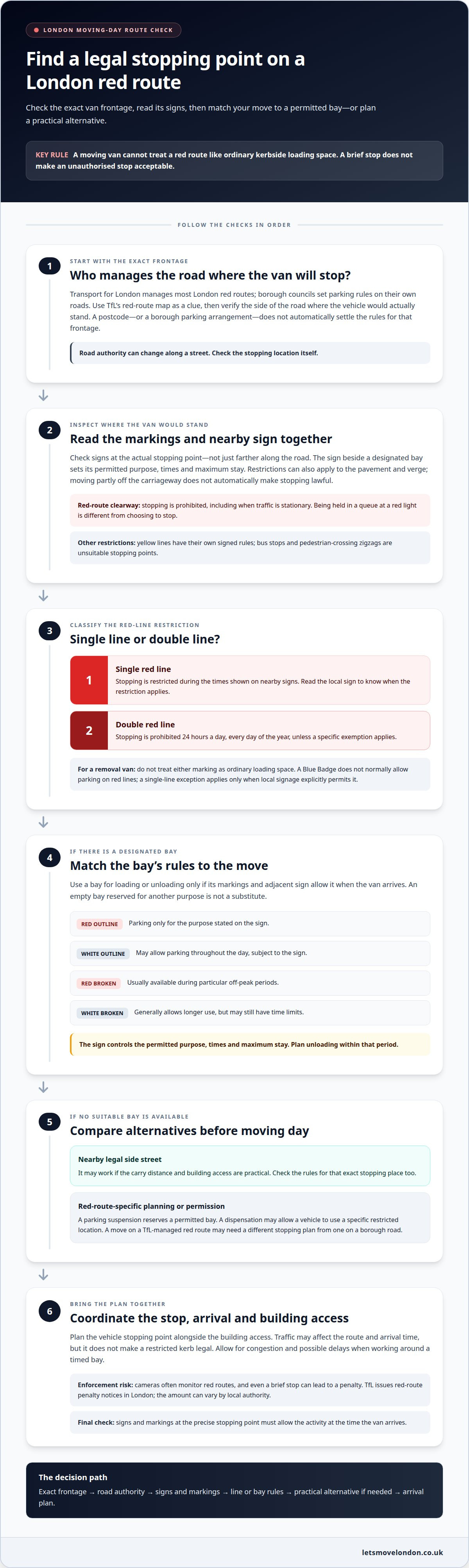
Red routes are major roads with stricter stopping controls, marked by red lines and signs. Their purpose is to keep traffic moving. According to the UK Government, single and double red lines prohibit stopping to park, load or unload, or board or leave a vehicle, except for licensed taxis and vehicles displaying a Blue Badge. The precise restriction depends on the line and its signs, so don’t treat either marking as ordinary loading space for a removal van.
Single red lines restrict stopping during the times shown on nearby signs. Double red lines prohibit stopping for 24 hours, every day of the year, unless a specific exemption applies. Double yellow lines prohibit waiting at any time, but double red lines prohibit stopping at any time. A Blue Badge does not normally allow parking on red lines; a single-line exception applies only when local signage explicitly permits it. Read the signs at the actual stopping point, not just those farther along the road.
London red routes can have different restrictions depending on the time and location. The signed hours determine when a single red line’s restriction applies, while double red lines apply at all times. Designated bays may have separate rules, so check their adjacent signs. A council parking arrangement does not automatically permit stopping on a red-route frontage.
Stopping or parking where red-route restrictions apply can result in a fine or Penalty Charge Notice. Transport for London issues red-route penalty notices in London. Drivers can make representations and, if these are rejected, appeal to an independent adjudicator. The amount can vary by local authority, so there is no single penalty figure for every case. A breakdown is not a general exemption: Transport for London’s published red-route rules list no breakdown exemption.
How red routes affect moving-day loading and unloading
Can you stop or park on a London red route while moving house? Not on a restricted section: parking, loading and unloading are prohibited unless a designated area and its sign allow the activity. Don’t assume a moving van can stop briefly at the kerb. Carrying a box inside doesn’t make an unauthorised stop acceptable.
Some red routes have marked bays for parking, loading or unloading. The adjacent sign sets the permitted purpose, times and maximum stay, so read it before using the space. A red-outlined box permits parking only for the purpose stated on its sign. A white-outlined box may allow parking throughout the day, subject to its sign. Red-broken-line bays are usually available during particular off-peak periods; white-broken-line bays generally allow longer use, but may still have time limits.
When navigating red routes on moving day in London, match the bay to the move. A loading bay may work for carrying furniture only if its sign allows loading when the van arrives. A bay reserved for another purpose isn’t a substitute, even if it looks empty. Restrictions can also apply to the pavement and verge, so moving the van partly off the carriageway doesn’t automatically make stopping lawful. Check the markings and sign where the vehicle would stand.
Navigating red routes on moving day in London also means planning around enforcement. Cameras often monitor red routes, and a brief stop can still lead to a penalty. Plan unloading around the bay’s permitted period and maximum stay. If no suitable bay is available, a legal nearby side street may work if the carry distance and building access are practical. For help arranging a London move, factor the road frontage into your plan before moving day.
Is this a red-route problem?
Start by checking the exact stopping frontage, not just the postcode. Transport for London manages most London red routes, while borough councils set parking rules on their own roads. TfL’s red-route map can help identify a controlled road near either address. A street may cross between different road authorities, so check the side where the van would actually stop before relying on a borough arrangement.
Check the road markings and nearby signs as well as the map. Red-route clearways prohibit stopping, including when traffic is stationary; being held in a queue at a red light is different from choosing to stop. Yellow lines have their own signed restrictions, which can vary by council. Bus stops and pedestrian-crossing zigzags are also unsuitable stopping points. A legal side street may be a practical alternative if access and the carrying distance work.
Traffic affects the route and arrival time, not whether a stopping place is legal. Use a navigation app to plan around red routes where possible, then allow for congestion near the destination. Moving outside busier periods, such as early morning or late afternoon on weekdays, may make the journey smoother. Even a short delay can disrupt a timed-bay plan, so allow for traffic without assuming a restricted kerb will become available.
Before the journey, include a vehicle condition check in the moving-day plan. Check tyre pressure against the vehicle manufacturer’s guidance, especially when the van is carrying a full load. UK law requires at least 1.6 mm of tread across the central three-quarters of each tyre’s breadth, around its whole circumference. These checks support a roadworthy journey, but they don’t change red-route restrictions. Keep the route, stopping frontage and building access in the same plan.
When special permission or planning may be needed
A house move on a TfL-managed red route may need a different stopping plan from one on a borough road. The key question is whether the van needs to stop directly outside or can use a practical nearby street.
Permits and Temporary Suspensions
A parking suspension reserves a permitted bay, while a dispensation may allow a vehicle to use a specific restricted location. For a moving van on a red route, don’t assume a borough permit or suspension authorises stopping. Red-route-specific guidance, planning or permission may apply. If direct access is essential, identify the road authority and frontage before relying on ordinary council arrangements.
Application Timing and Costs
For a borough-managed road, apply for a parking suspension around 5-10 working days before the move. Some councils require more notice, especially in busy periods or central locations, so the exact lead time depends on the borough. Applications generally need the bay’s exact location, move date and time, vehicle size and payment details. These details help the council assess the requested space.
These are general averages, not a universal tariff; the borough and requested arrangement affect the charge. A red-route frontage may follow a separate process, so a borough suspension alone may not permit the van to stop there. Allow time to resolve this before confirming where the vehicle will stop.
Coordinate road access with the building plan. For example, a permitted bay farther along the street may be impractical if furniture must pass through a narrow entrance or across a busy road. If direct stopping isn’t permitted, assess a legal nearby alternative and the resulting carry distance. Plan your London move around the frontage, access route and any required permission to reduce last-minute changes.
Let's Move London: Moving
Let's Move London provides residential and commercial moving services to help organise the practical work around moving day. Once you’ve identified the stopping restrictions and planned building access, a professional move can help coordinate the relocation around your vehicle arrangements.
Share the details that shape your move, including both addresses, access constraints and any planned alternative stopping point. This helps clarify the logistics, especially where a red-route frontage affects how belongings reach the property. If you need a temporary place for belongings, Let's Move London also offers storage.
For support with your move, contact Let's Move London to discuss your requirements.
Set Your Moving-Day Plan in Motion
A clear plan for navigating red routes on moving day in London starts with decisions made before the van sets off: where it can lawfully stop, how belongings will reach the property, and what alternative access is available. Keep these details with your moving arrangements so the road plan and the work at each address fit together.
Choose support that suits the size and needs of your move. Let's Move London offers moving, storage and man-and-van services for a full relocation, belongings that need temporary storage, or a smaller transport requirement. The right option depends on what needs moving and how you want to organise the day.
Share your moving requirements and the access details that will shape the plan. Contact Let's Move London to plan your move, and take the next step with a clearer path to moving day.
Frequently Asked Questions
Can I stop on a red route to drop someone off?
Only if the local signs allow it, and the stop is brief. A single red line may permit passenger drop-off during certain hours, but the sign controls the restriction at that location. This is different from unloading boxes or furniture for a house move. Don’t assume a quick stop is allowed simply because someone is waiting at the kerb.
Can Blue Badge holders park on red routes?
A Blue Badge doesn’t normally allow parking on single or double red lines. A single red line may allow it where local signs explicitly permit the exemption. A driver may also briefly pick up or set down a Blue Badge holder when the badge is correctly displayed and the vehicle moves away promptly. That passenger exception doesn’t provide a place to unload household belongings.
Are there any special parking rules for removals in Central London?
Central London moves can involve strict stopping controls, and an ordinary borough parking arrangement may not cover a TfL-managed red-route frontage. Treat the road outside each property as a separate access point: identify who manages it and whether a legal alternative is practical. If the van must stop directly outside, include the relevant permission or red-route planning in your move arrangements.
Can I park in resident bays or on yellow lines during a move?
Check the signs and local arrangements before using a resident bay or yellow line with a moving van. London borough rules differ, and the applicable arrangement depends on the street and its restrictions. Without the required permission, the vehicle may receive a Penalty Charge Notice or be towed. Include any council arrangement in the vehicle’s parking plan before moving day.
Can my moving company arrange parking permits for me?
Let's Move London can plan the move around vehicle access, but the moving booking itself is not parking permission. A suspension or permit is a separate arrangement with the authority responsible for the road, and a borough arrangement may not apply to a TfL-managed red route. Align the vehicle’s stopping plan and any required permission with the move date and property access.
What loading and unloading rules apply on London red routes?
Load or unload only where the road markings and adjacent sign permit it. A marked bay may specify its purpose, operating times and maximum stay; an empty space alone doesn’t make it suitable for a removal van. Red-route restrictions can also cover the pavement and verge. Plan where furniture will enter the property so the vehicle and carrying route both fit the permitted arrangement.



Comments